CS-466/566: Math for AI
Module 01: Course Introduction
The University of Alabama
2026-03-23
TABLE OF CONTENTS
Welcome
Welcome to CS-466/566: Math for AI!
Instructor Information
Instructor: Dr. Mahmoud Mahmoud
Institution: The University of Alabama
Email: mmahmoud@ua.edu
Office Hours: By appointment
Course Website
You can find all course materials, announcements, and updates on the Blackboard.
Prerequisites
A background in programming is recommended for this course. We will cover the basics from scratch.
Academic Integrity
All students are expected to adhere to the university’s academic integrity policy. Collaboration is encouraged, but all submitted work must be your own.
About Me
Experience
- Associate Professor, CS, The University of Alabama (Current)
- Associate Professor, ECE, NC A&T State University (2024-2025)
- Assistant Professor, ECE, NC A&T State University (2019-2024)
Research & Achievements
- Interests: Trustworthy AI, Cybersecurity, and Privacy in CPS.
- Fellowship: Summer Faculty Fellow at Fermi National Accelerator Laboratory.
- Editor: Editor IEEE Transactions on Dependable and Secure Computing
- Funding: Active external funding from NSF, NASA, DOE, CIA, etc.

What do you think this course is about?
- Is this a traditional pure mathematics course?
- Answer: ❌ not exactly
- Is this a pure machine learning course?
- Answer: ❌ not exactly
- Is this a programming course?
- Answer: ❌ not exactly
- Answer: The course spans the four pillars of machine learning: ✔
- Linear Algebra
- Calculus
- Probability & Statistics
- Optimization
Machine Learning and AI Everywhere!
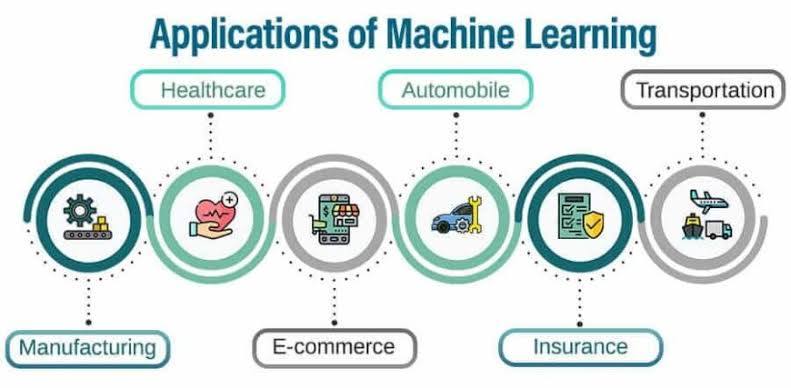
TABLE OF CONTENTS
Course Structure and Content
| Week | Tuesday | Thursday | Topic | Source |
|---|---|---|---|---|
| 1 | — | Jan 8 | Course Introduction + Motivation; What is Math for ML? | Syllabus |
| 2 | Jan 13 | Jan 15 | The Geometry of Data | Ch 1–2 |
| 3 | Jan 20 | Jan 22 | Computational Linear Algebra | Ch 3–4 |
| 4 | Jan 27 | Jan 29 | Systems & Eigen-Geometry | Ch 5–6 |
| 5 | Feb 3 | Feb 5 | Dimensionality Reduction & Factorization | Ch 7 |
| 6 | Feb 10 | Feb 12 | Graphs & Stochastic Systems | Ch 8 + Supp. |
| 7 | Feb 17 | Feb 19 | Calculus Foundations for ML | Ch 9–11 |
| 8 | Feb 24 (Q&A) | Feb 26 (Midterm) | Midterm Review & Exam | — |
| 9 | Mar 3 | Mar 5 | The Engine of Learning (Derivatives) | Ch 12 |
| 10 | Mar 10 | Mar 12 | Single-Variable Optimization & Integration | Ch 13–14 |
| — | Mar 17 | Mar 19 | Spring Break – No Class | — |
| 11 | Mar 24 | Mar 26 | Multivariable Calculus | Ch 15–16 |
| 12 | Mar 31 | Apr 2 | High-Dimensional Optimization | Ch 17 |
| 13 | Apr 7 | Apr 9 | Probability Spaces | Ch 18 |
| 14 | Apr 14 | Apr 16 | Random Variables & Distributions | Ch 19 |
| 15 | Apr 21 | Apr 23 (Last Class) | Expectation & Information Theory | Ch 20 + Supp. |
** Timeline and content are subject to change depending on the pace of the class.**
TABLE OF CONTENTS
Resources and Python Help
- Recommended Books (No book required):
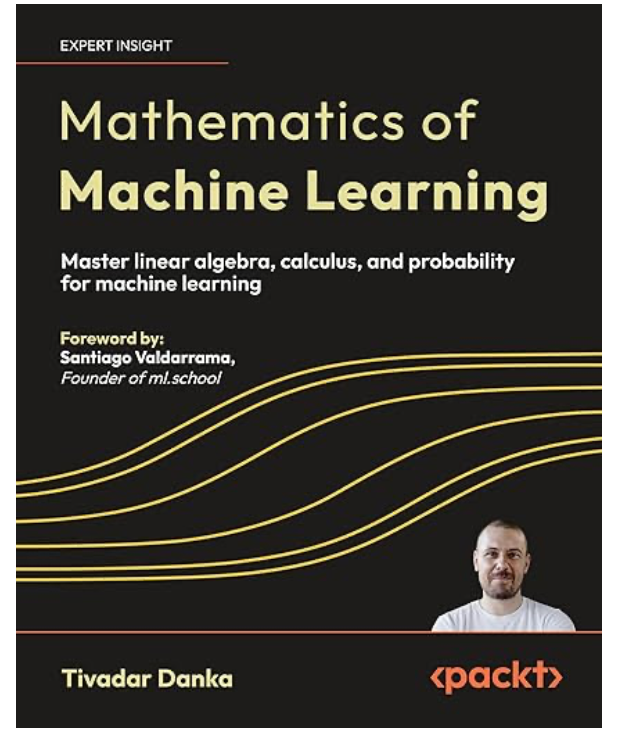
- Mathematics of Machine Learning (Tivadar Danka). Master linear algebra, calculus, and probability for machine learning.
- Mathematics for Machine Learning (Deisenroth, Faisal, Ong).
- Visual Learning:
- 3Blue1Brown (Linear Algebra, Calculus, Neural Networks).
- Python Libraries:
- Core: NumPy, SciPy, Matplotlib.
- Autodiff & DL: PyTorch, JAX.
What you need to know?
- Some Machine Learning Knowledge
- This is not a pure ML/Programming/Math course.
- Knowledge of Python
- Preferably Python for ML.
- Experience with Jupyter Notebooks or Google Colab is helpful.
- Knowledge of statistics and probability is strongly recommended!

Class Expectations
- Emphasis on interaction — lots of it!
- I encourage questions from you throughout the class.
- Don’t hesitate — ask immediately whenever something isn’t clear.
- You might get a bonus point for your questions!
- Please stay engaged: avoid chatting with friends, working on other courses, or distracting others during class.
TABLE OF CONTENTS
Assessments and Course Resources
| Component | CS 466 | CS 566 |
|---|---|---|
| Labs / Programming Assignments | 45% | 45% |
| Quizzes & Homework | 15% | 15% |
| Midterm Exam | 15% | 10% |
| Final Exam | 25% | 15% |
| Graduate Project | — | 15% |
| Total | 100% | 100% |
Course Resources
- All papers available per lecture.
- All lecture notes available per lecture.
- No required book but recommended resources are available.
Programming Assignments
- 4–5 assignments throughout the semester covering:
- Linear Algebra
- Calculus
- Probability
- Optimization
- All submissions via Blackboard.
- Assignments are individual.
- Programming + Report.
- Google Colab recommended.
Quizzes & Homework
- Weekly homework assignments.
- All submissions via Blackboard.
- Assignments are individual.
- Math style questions.
- Due at specified deadlines.
- 10% penalty per day late.
- Max 3 days late.
- >3 days = Zero.
- No extensions except emergencies.
Class Contributions (+5%)
- Pop Attendance (1 point)
- \(> 50%\): 1 pt | \(> 25%\): 0.5 pts | \(< 25%\): 0 pts
- Knowledge Quiz (1 point)
- Short quizzes to check understanding.
- Participation (3 points)
- Active discussion.
- Ask/answer questions.
- Sticky note for contributions.
Grading Scheme
| Grade | Description |
|---|---|
| A+ | 95-100 |
| A | 90-94 |
| A- | 88-90 |
| B+ | 85-87 |
| B | 83-84 |
| B- | 80-82 |
| C+ | 77-79 |
| C | 73-76 |
| C- | 70-72 |
| D+ | 67-69 |
| D | 63-66 |
| D- | 60-62 |
| F | Below 60 |
| Grade | Description |
|---|---|
| A | 90-100 |
| B | 80-89 |
| C | 70-79 |
| D | 60-69 |
| F | Below 60 |
TABLE OF CONTENTS
Midterm and Final Exams
Overview
- The midterm and final exams together are worth 40% (CS 466) / 25% (CS 566) of your final grade.
- Exams will feature “old style” questions—expect clear, direct problems that test your understanding, not tricky or ambiguous items.
Expected Dates
- Midterm Exam: Week 7 (exact date to be announced)
- Final Exam: During the official final exam period (date set by the university)
Grading Policy
- If needed, the highest mark achieved on the exam will be considered the full mark.
- All students’ scores may be scaled relative to the top score to ensure fairness.
What to Expect
- Questions will focus on core concepts, problem-solving, and your ability to apply what you’ve learned.
TABLE OF CONTENTS
Project Expectations (15%) and Due Dates
Project Overview
- Projects are individual.
- Project Theme: Choose a core mathematical concept (e.g., Optimization, Matrix Factorization, Probability) applied to AI, provide a proposal, implement the concept from scratch (or a novel variation), and write a research paper.
Key Milestones & Deadlines
- Project Presentations: (Most likely Video Recording)
- Short in-class presentations with peer feedback.
- Final Deliverables Due: End of Week 16 (Dec 5)
- Written report/paper (5–8 pages) and code submission.
Expectations
- Clear problem statement and motivation.
- Demonstration of understanding of course concepts.
- Well-documented code and reproducible experiments.
- Insightful analysis and discussion of results.
- Proper citation of all sources and related work.
TABLE OF CONTENTS
Academic Integrity - Collaboration Guidelines
- Collaboration is encouraged!
- Over the line
- Showing your work to a friend – OK
- Sending your work to a friend – Not OK
- Finding sources, ideas, examples – OK
- Copying text, ideas, code – Not OK
- Using ChatGPT/LLM to help with part of the code – OK (In most cases)
- Copying all code from ChatGPT/LLM – Not OK
- Using whatever ML/DL/AI library in Python – OK
- Sometimes, you will be asked to explain your code
Academic Integrity - Zero Tolerance Policy
- Zero tolerance!
- Immediate failure for the assignment
- If repeated: failure of the course and referral to the Office of Academic Integrity
- I do what I say. So don’t do it!
- Random search
- Testing code for statistical similarity; renaming variable names is not going to fool us!
- Other technologies
Academic Integrity - Final Warning
- Reports/assignments/other tasks are your work, so never ever copy from others
- Or do not give it to others
- If detected, you will get a zero
- No exceptions
- PLEASE don’t violate
- No exception will be provided
Thank You!


The University of Alabama